

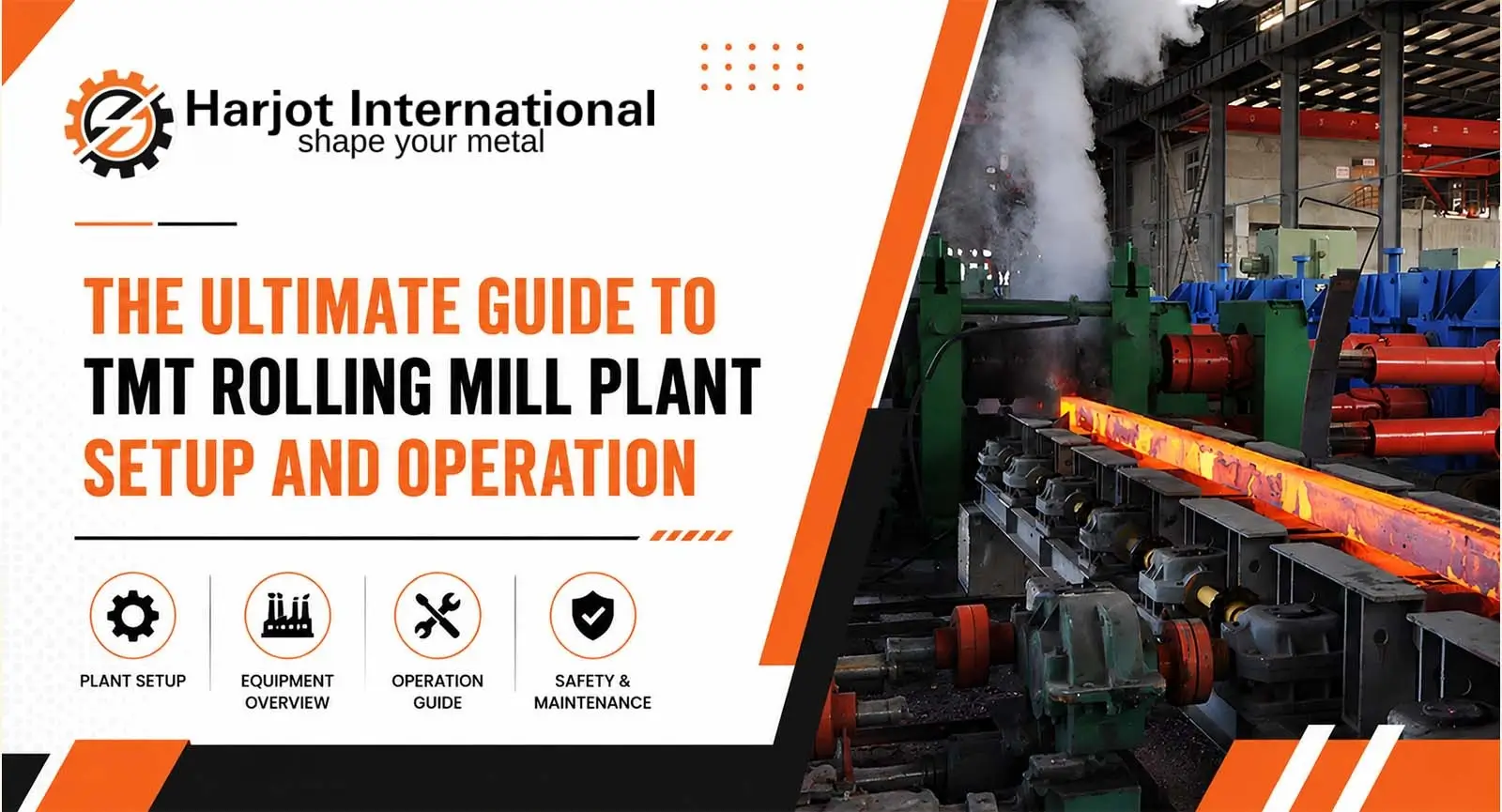
Setting up a TMT rolling mill plant is one of the bigger decisions in the steel manufacturing space. It takes serious investment, detailed planning, and the right equipment working together from day one. Done well, you end up with a facility that produces quality TMT bars consistently for years. Done poorly, you spend that time dealing with breakdowns, quality rejections, and production gaps that cost far more than they should. Whether you are looking at this as a new project or scaling up what you already have, here is a practical guide to what actually goes into it.
What is a TMT Rolling Mill Plant?
A TMT rolling mill plant is a facility that converts steel billets into TMT bars — the reinforced steel bars that go into virtually every construction project today, from small residential buildings to large bridges and infrastructure.
TMT stands for Thermo-Mechanically Treated. The name tells you what the process does — steel gets rolled under heat and then goes through a controlled cooling process that changes its internal structure. The output is a bar with a hardened outer surface and a softer, more flexible core. That is what makes it work so well in construction — it handles both weight and movement without giving way.
A full plant puts together furnace systems, rolling equipment, cooling lines, and finishing machinery. Each part feeds the next, and the whole line has to work in sequence to produce bars that consistently hit grade.
How the TMT Manufacturing Process Works
The TMT manufacturing process moves through a set sequence of steps. Knowing each one helps with both planning and running day-to-day operations:
- Billet Heating — Billets go into a reheating furnace and are brought up to rolling temperature, usually between 1100°C and 1200°C
- Rough Rolling — The hot billet enters the first rolling stands, which reduce its size and start forming it into bar shape
- Intermediate Rolling — More rolling stands continue reducing the cross-section and shaping the profile
- Finishing Rolling — The bar reaches its final diameter through the last set of finishing stands
- Quenching — The bar passes through a water cooling system that drops the surface temperature rapidly while the core stays hot
- Self-Tempering — Heat from the core moves back toward the surface and tempers it — this is what gives TMT bars their layered structure
- Cooling Bed — Bars are spread out to cool down evenly before cutting
- Cutting and Bundling — Bars are cut to standard lengths, tied into bundles, and prepared for dispatch
TMT Rolling Mill Plant Setup
A successful TMT plant setup is mostly won or lost at the planning stage — before a single piece of equipment is installed. The key things to sort out early:
- Production capacity — Your target output in tonnes per annum drives the sizing of every major equipment item in the plant
- Billet supply — Confirm a reliable source of consistent-quality billets before committing to production targets
- Plant layout — Design for smooth material flow from billet intake through to finished bar dispatch, with enough space for each stage and future expansion
- Power infrastructure — Rolling mills are heavy power consumers. Stable power supply with backup provisions for critical systems is not optional
- Water system — The quenching process needs a steady water supply with proper recycling and treatment in place
- Statutory approvals — Environmental clearances and pollution control requirements vary by location and should be addressed before construction begins
Skipping or rushing through any of these at the start almost always creates problems that are harder and more expensive to fix once the TMT Rolling Mill Plant is operational.
Essential TMT Equipments in a Rolling Mill Plant
A rolling mill plant is only as good as the equipment running inside it. The main TMT equipments that make up a complete plant:
- Reheating Furnace — Where every production cycle begins. Fuel type — gas, oil, or coal — depends on what is available and cost-effective in your location
- Rolling Mill Stands — Roughing, intermediate, and finishing stands. Each set of rolls is sized for progressive reduction down to the finished bar diameter
- Pinion Stands and Gear Boxes — Transfer power from the drive motors to the rolling stands. They carry continuous load and need to be built well and kept in alignment
- Drive Motors — Sized according to rolling speed and the capacity of the mill
- Quenching Box — Controls the rapid surface cooling that creates the TMT bar’s strength profile. Thermex is the most common system used for this
- Cooling Bed — Bars cool here after quenching. Even cooling matters — it directly affects final bar straightness and dimensional consistency
- Shear Machines — Cut bars at different points in the process. Cobble shears remove defective material quickly to keep the line moving
- Bundling and Tying Equipment — Prepares finished bars for storage and outward dispatch
- Pollution Control Systems — Handles furnace emissions and other outputs as required by regulations
Common Operational Challenges and How to Handle Them
No plant runs without challenges. These are the ones that come up most often in a TMT Rolling Mill Plant:
- Billet quality variation — When billet composition is inconsistent, rolling behaviour and final bar properties both suffer. A supplier who provides consistent material with proper documentation is worth more than one who is simply cheap
- Roll wear — Rolls wear down gradually and need regular checking. Letting them go too long affects bar dimensions and surface quality
- Temperature inconsistency — Furnace temperature swings and quenching water temperature variation both affect the mechanical properties of finished bars. Both systems need regular calibration and monitoring
- Power fluctuations — Unstable voltage during rolling affects product consistency and can trip equipment. Voltage stabilisation is worth considering where supply reliability is a concern
- Unplanned stoppages — Gear box failures, bearing failures, and motor faults are the most disruptive. Keeping a stock of critical spares on hand reduces downtime significantly when something does go wrong
TMT Rolling Mill Plant Maintenance Tips
Preventive maintenance is what separates plants that run efficiently for decades from those that are constantly dealing with breakdowns:
- Inspect rolling stand rolls and bearings regularly for wear and surface condition
- Monitor gear box oil levels and quality, with scheduled oil analysis
- Check quenching system water flow rates and temperature consistently
- Verify rolling stand alignment periodically — misalignment affects bar dimensions and surface finish
- Maintain a dedicated stock of high-wear spare parts — rolls, bearings, seals, coupling elements
- Run structured training for both operators and maintenance personnel on equipment-specific procedures
Plants that treat maintenance as a priority rather than an afterthought consistently outperform those that do not — in uptime, product quality, and overall operating cost.
Look for the Best Brands!
For anyone setting up or upgrading a TMT Rolling Mill Plant, the equipment you choose and the expertise behind it makes a real difference to how the plant performs long-term. Harjot International has been manufacturing and supplying rolling mill equipment for decades, supporting plant setups with reliable machinery, technical input at the planning stage, and ongoing support through commissioning and beyond.
Frequently Asked Questions
How much land does a TMT rolling mill plant require?
What raw material does a TMT rolling mill use?
How long does it take to set up a TMT rolling mill plant?
Can a TMT plant produce different bar sizes?
What is the difference between TMT bars and ordinary steel bars?
What is the minimum capacity for a TMT rolling mill plant?
Smaller plants typically start at 30,000 to 50,000 tonnes per year. Medium and large plants go from 100,000 tonnes upward depending on rolling speed and the number of strands.
What is the Thermex quenching system?
What maintenance does rolling mill equipment need?

Harjot International
With over 25 years of experience, Harjot International, based in Punjab, India, has built a strong reputation as a trusted provider of heavy industrial machinery.