

Quick Summary:
A bar bundling machine counts finished TMT bars, gathers them into neat bundles and ties them automatically. It replaces slow, risky manual bundling at the end of the rolling line. This guide explains how it works, its main parts, the problems it solves, the types available and what to check before buying. It is useful for mill owners, plant managers and procurement teams.
What Is a Bar Bundling Machine?
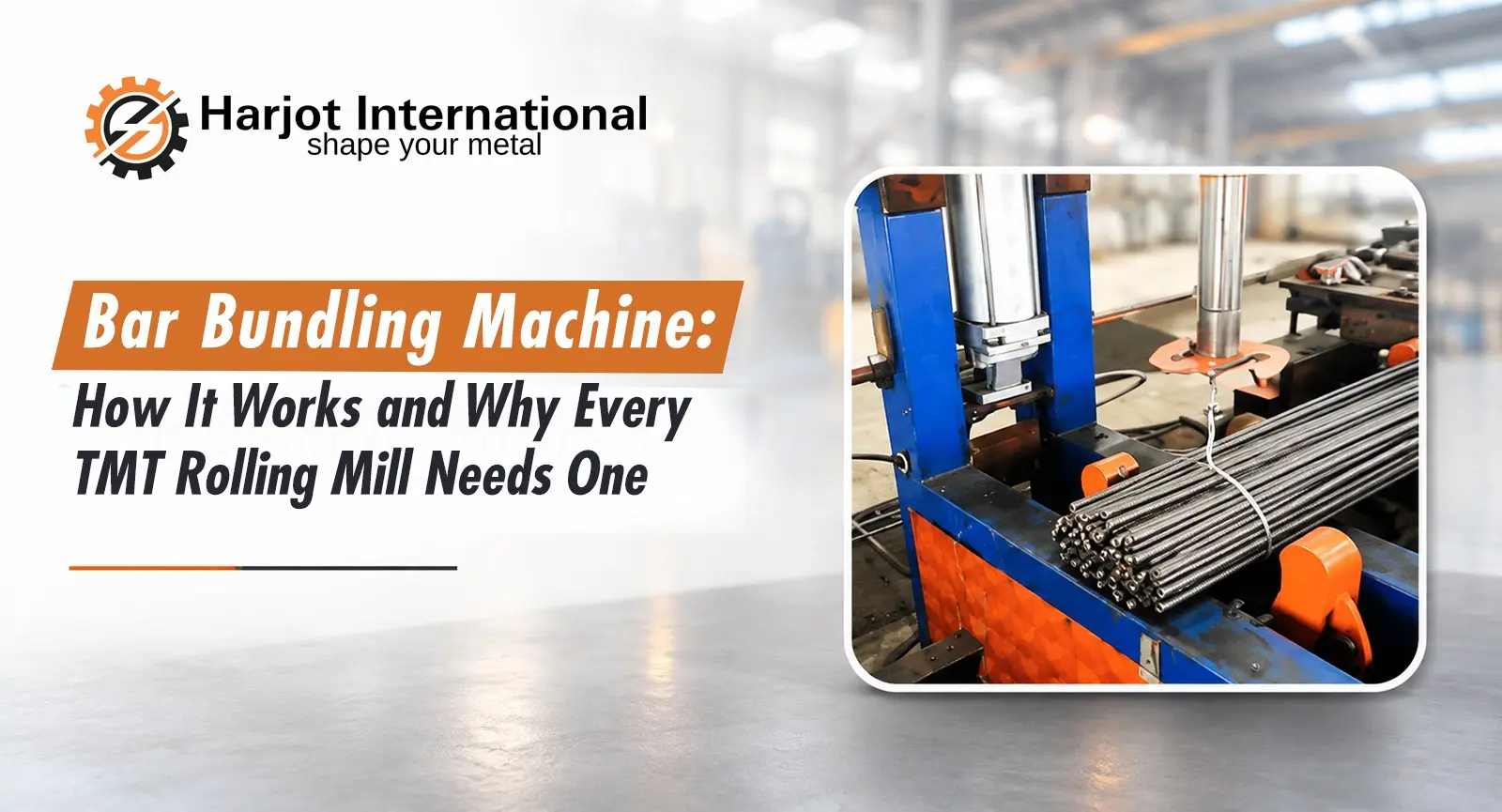
A Bar Bundling Machine is an automatic or semi-automatic machine that collects steel bars, counts them, forms a bundle and secures it with binding wire or strap. It is used for TMT bars, rebars, round bars, angles and other long steel products.
You may also hear it called a rebar bundling machine or a TMT bar bundler. Its job is to give the mill neat, equal and secure bundles that are easy to store, weigh and transport.
Where It Fits in a TMT Rolling Mill
The machine sits at the end of the finishing area. A typical TMT line runs like this.
- Billets are heated in the reheating furnace.
- They are rolled into bars in the rolling mill stands.
- The bars pass through a quenching and self-tempering system.
- They cool on the cooling bed.
- A cold shear cuts the bars to the required length.
- The bars move to the counting and bundling area.
- The bundles are weighed, tagged and sent to storage or dispatch.
The bundling stage is the last step before the product leaves the mill, so quality and speed here affect delivery, customer satisfaction and brand image.
How Does a Bar Bundling Machine Work?
The process is simple and runs in a cycle.
- Cut bars arrive on a conveyor or from the cooling bed.
- A counting system, using sensors or an automatic counter, tracks the number of bars.
- Bars are collected in a forming trough or bundling channel until the set count is reached.
- A compacting device squeezes the bars into a tight, uniform shape.
- Tying heads wrap binding wire or strap around the bundle at set positions and twist or seal it.
- The finished bundle is pushed out onto a discharge conveyor or table.
- The cycle repeats, and the PLC records the number of bundles.
Operators can set the bar count, the number of ties and the bundle size from a control panel.
Why Every TMT Rolling Mill Needs One
Manual bundling may look cheap at first, but it hides many costs.
Problems with manual bundling
- Workers lift and tie heavy bars, which causes fatigue and injuries.
- Bar counts vary, leading to complaints and disputes with customers.
- Bundles are loose or uneven, so they are hard to stack and load.
- Speed depends on the crew, which can slow down the whole line.
- More labour is needed for every shift.
- Bundles may come apart during transport.
How a bar bundling machine helps
- Consistent counts: every bundle has the same number of bars, which builds trust with buyers.
- Higher speed: the machine keeps up with the output of the mill and does not become the bottleneck.
- Neat, tight bundles: compact bundles are easier to stack, store and load.
- Better safety: workers stay away from heavy and hot material.
- Less labour: fewer people are needed at the end of the line.
- Accurate weight control: consistent bundles make weighing and billing easier.
- Better presentation: professional-looking bundles support the mill’s brand.
- Less rework and loss: fewer loose bars, recounts and customer claims.
For mills that aim to grow output or supply large customers, this is no longer a luxury. It is a practical need.
Types of Bar Bundling Machines
- Manual or semi-automatic bundlers: the operator loads bars and starts the tying. They suit smaller mills.
- Fully automatic bundling machines: counting, forming, tying and discharge are done automatically. They suit high-capacity lines.
- Wire tying machines: use binding wire, which is common for TMT bars.
- Strapping machines: use steel or plastic strap for a clean, strong tie.
- Single-head and multi-head machines: more tying heads give faster cycles and more ties per bundle.
- Machines for different products: some are built for TMT bars, others for angles, flats or pipes.
The right type depends on bar size, production rate and the type of tie your customers expect.
What to Check Before Buying
- Bar size range: make sure it covers all diameters you roll.
- Bundle size and weight: match it to your dispatch and customer needs.
- Production speed: the machine must keep up with the mill output.
- Counting accuracy: ask about the counting method and its reliability.
- Tying method: wire or strap, and the number of ties per bundle.
- Build quality: a strong frame and wear-resistant parts that survive heat, dust and scale.
- Automation level: PLC control, recipe storage and fault alerts.
- Safety features: guards, emergency stops and sensors.
- Integration with the line: it should fit with your cooling bed, shear and conveyors.
- Customisation: special bundle shapes, lengths or layouts.
- Spare parts and service: quick support is crucial for a continuous line.
Common Mistakes to Avoid
- Choosing by price alone: weak frames and poor sensors cause constant stoppages.
- Buying too slow a machine: it becomes a bottleneck when the mill speeds up.
- Ignoring bar size changes: the machine must handle all sizes you roll.
- Skipping operator training: misuse shortens the life of the machine.
- Overlooking spares: long waits for tying head parts halt dispatch.
Basic Maintenance Tips
- Clean scale, dust and bar debris from the machine regularly.
- Lubricate moving parts as per the manual.
- Check the counting sensors and clean their lenses.
- Inspect tying heads, wire guides and cutters for wear.
- Check hydraulic or pneumatic parts for leaks, where fitted.
- Test safety devices at regular intervals.
- Keep a log of servicing and part changes.
Conclusion
The end of the rolling line is where a mill meets its customer. A bar bundling machine gives that moment accuracy, speed and a neat finish, while keeping workers safe. It reduces counting disputes, speeds up dispatch and supports the brand image of the mill. If you need bundling machines or other rolling mill equipment, in standard or customised models, you can get in touch with Harjot International, a manufacturer and supplier known for quality products and technical support.
Frequently Asked Questions
What is a bar bundling machine?
How does a steel bundling machine work?
Why is a bundling machine needed in a TMT rolling mill?
What products can it bundle?
Can a bundle bending machine count the bars automatically?
What is the capacity of a bar bundling machine?
How do I choose a bar bundling machine?

Harjot International
With over 25 years of experience, Harjot International, based in Punjab, India, has built a strong reputation as a trusted provider of heavy industrial machinery.